


[In the Media] Rethinking Health Security and Structural Resilience of Healthcare Systems in Light of the Naphtha Crisis (Nikkei Medical “My Perspective”, May 7, 2026)
date : 5/7/2026
Tags: Planetary Health

![[In the Media] Rethinking Health Security and Structural Resilience of Healthcare Systems in Light of the Naphtha Crisis (Nikkei Medical “My Perspective”, May 7, 2026)](https://hgpi.org/en/wp-content/uploads/sites/2/eyecatch_sugawara-3-17.png)
On May 7, 2026, an article by Mr. Joji Sugawara, Vice President of Health and Global Policy Institute (HGPI), titled “Rethinking Health Security and Structural Resilience of Healthcare Systems in Light of the Naphtha Crisis” was published in the “My Perspective” column of Nikkei Medical.
This article analyzes the complex, multilayered vulnerabilities in modern healthcare’s dependence on petrochemical products and fossil fuels, triggered by the 2026 “Naphtha Crisis” arising from Middle East geopolitical instability. From a Planetary Health perspective, it presents practical prescriptions for building structural resilience in healthcare systems.
■ Key Points of the Article
Structural Vulnerabilities from Modern Healthcare’s Oil Dependence
Modern healthcare exhibits multilayered dependencies on petrochemicals and fossil fuels, from active pharmaceutical ingredients and medical consumables like infusion tubing and syringes to helium for MRI cooling and hospital electricity and air conditioning systems. This vulnerability has repeatedly surfaced in past crises including the Great East Japan Earthquake and Kumamoto Earthquake. The joint Ministry of Health, Labour and Welfare and Ministry of Economy, Trade and Industry “Task Force for Securing Pharmaceuticals, Medical Devices, and Medical Supplies Affected by the Middle East Situation” established on March 31, 2026, marks a pivotal turning point—the first formal recognition of medical supply security as an integrated challenge spanning health, industrial, and energy policy. As shown in Table 1, the Task Force is composed of members with substantive authority to ensure effective implementation.
Planetary Health and the Evolving Role of Healthcare Professionals
Based on the Planetary Health concept that “human health can only be achieved within a healthy planetary environment,” fundamental redesign of healthcare systems is required. Japan’s healthcare sector accounts for approximately 6.4% of national greenhouse gas emissions, ranking fourth globally in absolute terms. Healthcare professionals are called upon to fulfill three key roles: (1) clinical practitioners promoting evidence-based appropriate care, (2) communicators explaining climate and resource challenges, and (3) advocates advancing decarbonization policies.
Leading Domestic and International Initiatives Linking Policy and Practice
Transformative initiatives linking policy and practice are advancing, including the UK National Health Service’s (NHS) world-first net-zero commitment for an entire healthcare system, the Japan Primary Care Association’s Climate Emergency Declaration (Hamamatsu Declaration), and practical activities by Green Practice Japan (Midori no Doctors). Japan’s “Grand Design and Action Plan for a New Form of Capitalism—2025 Revised Edition” explicitly enshrines these issues as national strategic priorities. On building climate-resilient healthcare systems, it states: “At the national level, Japan will also implement initiatives related to climate-resilient health and medical systems, low-carbon and sustainable health and medical systems, and net zero commitments (to achieve net zero greenhouse gas emissions) in the health and medical sector.” On circular economy integration, it commits to “Study on incorporating waste from the health, medical and nursing care sectors into the circular economy.“
A Three-Stage Roadmap for Resilience: “Prepare, Reduce, Transform”
The article proposes a practical three-stage approach for healthcare professionals and institutions: Stage 1 “Prepare” (visualizing dependencies on medical supplies and energy, sharing regional priority allocation rules), Stage 2 “Reduce” (implementing evidence-based appropriate care and planned upgrades to energy-efficient equipment), and Stage 3 “Transform” (introducing renewable energy and implementing circular procurement policies). Short-term crisis response and long-term structural reform must proceed simultaneously.
Table 1. Members of the Task Force for Securing Pharmaceuticals, Medical Devices, and Medical Supplies Affected by the Middle East Situation
| Role | Ministry/Agency | Position |
| Head | Minister, Ministry of Health, Labour and Welfare | |
| Minister, Ministry of Economy, Trade and Industry | ||
| Deputy Head | Ministry of Health, Labour and Welfare | Chief Medical and Global Health Office |
| Ministry of Economy, Trade and Industry | Director-General for Policy Planning and Coordination | |
| Vice Head | Ministry of Health, Labour and Welfare | Director-General for Crisis Management and Medical Technology |
| Director-General for Pharmaceutical Industry Promotion and Medical Information | ||
| Ministry of Economy, Trade and Industry | Director-General, Manufacturing Industries Bureau | |
| Director-General for Commerce and Service Industry Policy | ||
| Director-General, Natural Resources and Fuel Department, Agency for Natural Resources and Energy | ||
| Members | Ministry of Health, Labour and Welfare | Director, Health Sciences Division, Minister’s Secretariat |
| Director, Regional Medical Planning Division, Health Policy Bureau | ||
| Director, Pharmaceutical Industry Promotion and Medical Information Planning Division, Health Policy Bureau | ||
| Counselor (General Policy) | ||
| Ministry of Economy, Trade and Industry | Director, Budget and Accounts Division, Minister’s Secretariat | |
| Director, Materials Division, Manufacturing Industries Bureau | ||
| Director, Medical and Welfare Equipment Industry Office, Healthcare Industries Division | ||
| Director, Policy Division, Natural Resources and Fuel Department, Agency for Natural Resources and Energy | ||
While this article primarily focuses on healthcare settings’ response to “oil dependence” triggered by the energy crisis, truly enhancing resilience and realizing “structural strengthening of healthcare systems from a Planetary Health perspective” as comprehensive “health security” requires the active involvement of the Ministry of the Environment (MOE) in addition to the Ministry of Health, Labour and Welfare and the Ministry of Economy, Trade and Industry (see Table 1). Only through the participation of the MOE, which oversees climate change adaptation, biodiversity conservation, and circular society policies, can the transition away from healthcare’s oil dependence toward sustainable healthcare systems function as genuine cross-sectoral policy integration that transcends bureaucratic silos.
The full article is available on Nikkei Medical with free membership registration (Japanese only).
Related Posts
-
2026-05-01
[Activity Report] HGPI Participates in Dialogue to Develop "Five Recommendations to Protect Communities from a Changing Climate" (April 9, 2026)
-
2026-04-27
[In the Media] "Final Report on the Information Collection and Confirmation Survey on Climate Change Countermeasures and Planetary Health in the Health Sector Worldwide" (JICA, January 2026)
-
2025-12-22
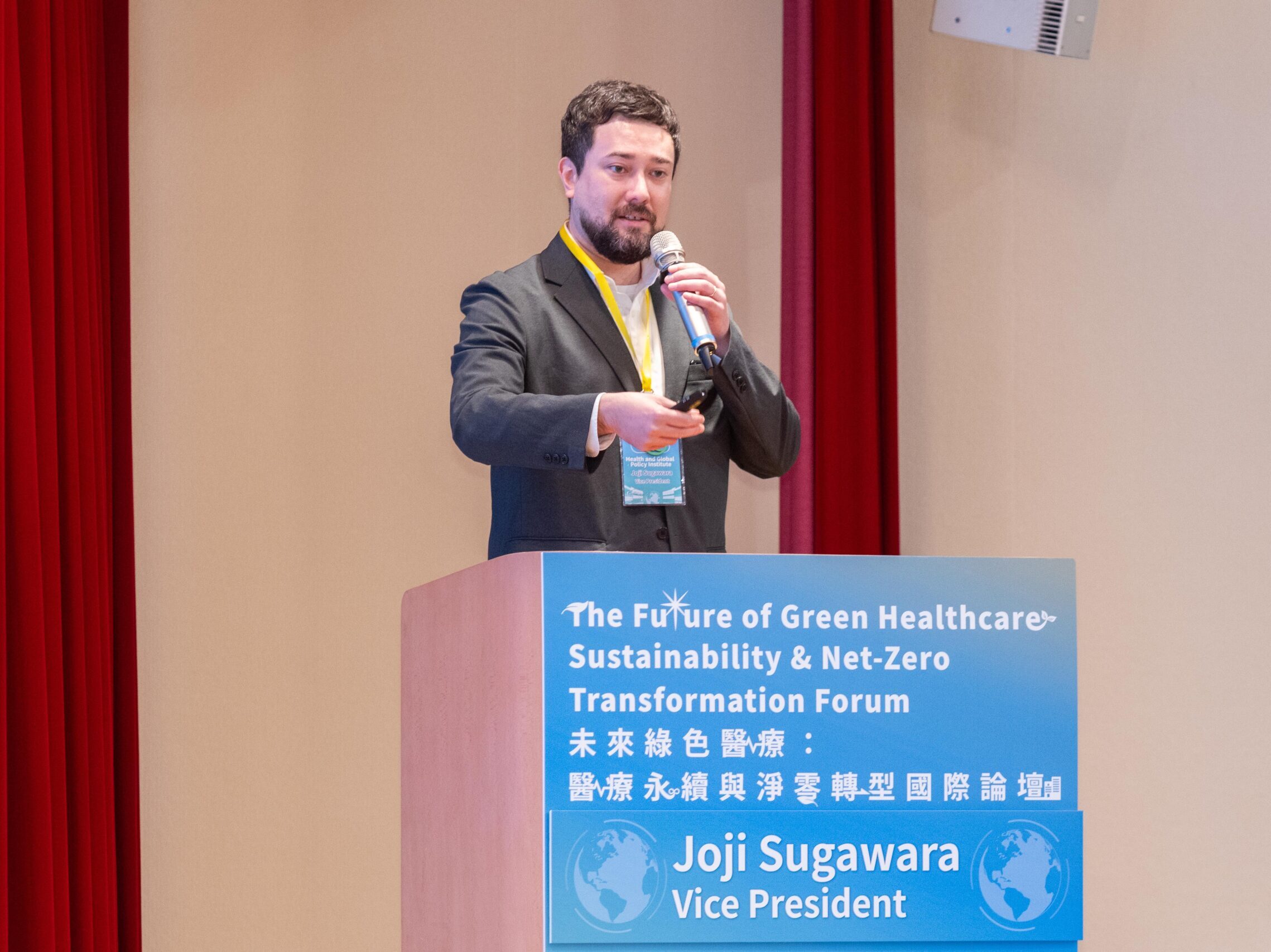
[Lecture Report] The Future of Green Healthcare: International Forum on Healthcare Sustainability and Net-Zero Transformation (Institute for Information Industry (III), November 25, 2025, Taipei, Taiwan)
-
2026-04-15
[HGPI Policy Column] (No.70) — From the Planetary Health Project “Part 17: The Lancet Countdown: A ‘Lifeline’ for Health and Economy Brought about by Climate Action”
Top Research & Recommendations Posts
- [Research Report] Energy Conservation and Greenhouse Gas Emissions Reduction in Healthcare Facilities: Case Studies from New Construction and Facility Renewal (March 16, 2026)
- [Research Report] Perceptions, Knowledge, Actions and Perspectives of Healthcare Organizations in Japan in Relation to Climate Change and Health: A Cross-Sectional Study (November 13, 2025)
- [Public Comment Submission] “The 7th Science, Technology and Innovation Basic Plan” (Draft) (February 19, 2026)
- [Policy Recommendations] Policy Recommendations in the Field of Blood Disorders “Building a Healthcare Ecosystem Centered on Patients and Those Affected” (April 13, 2026)
- [Research Report] The 2026 Public Opinion Survey on Healthcare in Japan (February 13, 2026)
- [Research Report] The 2025 Public Opinion Survey on Healthcare in Japan (March 17, 2025)
- [Policy Recommendations] Developing a National Health and Climate Strategy for Japan (June 26, 2024)
- [Policy Recommendations] Mental Health Project: Recommendations on Three Issues in the Area of Mental Health (July 4, 2025)
- [Research Report] AMR Policy Update #2: WHO’s First Report on Fungal Infection—Bridging the Gap Between Clinical Practice and R&D
- [Research Report] Building a Mental Health Program for Children and Measuring its Effectiveness (June 16, 2022)
![[Research Report] The 2026 Public Opinion Survey on Healthcare in Japan (February 13, 2026)](https://hgpi.org/en/wp-content/uploads/sites/2/HGPI_The2026PublicOpinionSurveyOnHealthcareInJapan_20260213.jpg)
![[Publication Report] Future of the Healthcare System Project “Policy roadmaps for acting early on NCDs” (March, 2026)](https://hgpi.org/en/wp-content/uploads/sites/2/HGPI_PHSSR-Report_20260421.png)
